
COMMERCIAL AUTO INSURANCE
Commercial auto insurance covers vehicles your business owns, leases, or uses for work.
Personal auto policies exclude most business use of a vehicle. If you have vehicles in the business name, employees driving on company time, or any regular business driving beyond commuting, you need commercial auto coverage.
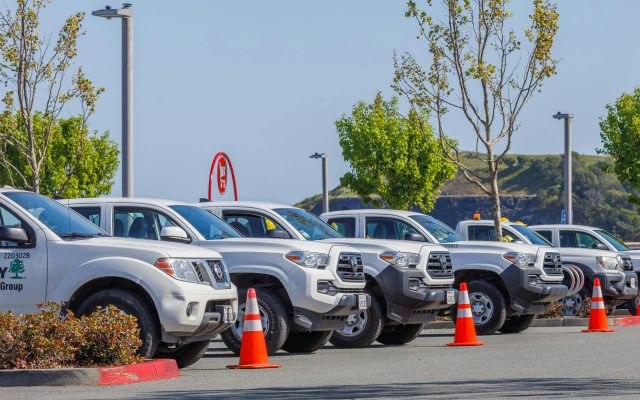
What it covers
What commercial auto covers.
What it covers
Liability coverage
Pays for injuries and property damage your business causes to others while operating commercial vehicles. Liability coverage limits are typically much higher than personal auto because business risk is higher.
What it covers
Physical damage
Collision and comprehensive coverage on the vehicles themselves. Includes damage from accidents, theft, vandalism, weather, and falling objects.
What it covers
Hired and non-owned auto
Liability coverage when employees drive personal vehicles for business or when the business rents vehicles. Hired and non-owned auto is often added to a business owners policy for businesses without owned vehicles.
What it covers
Uninsured and underinsured motorist
Pays medical bills and lost wages if your driver is hit by an uninsured driver. Underinsured motorist coverage helps when the at-fault driver does not carry enough. Important when employees are operating company vehicles. Required coverage in most states.
Where policies have edges
What commercial auto does not cover.
Not covered
Personal use exclusions
Some commercial auto policies restrict or exclude personal use of company vehicles. Confirm the policy form allows the personal use you actually have.
Not covered
Cargo and goods in transit
What you are hauling is generally excluded under commercial auto. Inland marine or motor truck cargo coverage is needed for goods, materials, or equipment in transit.
Not covered
Specialized equipment on the vehicle
Cranes, lifts, and similar equipment mounted on a vehicle have special coverage rules. Damage to the equipment itself often needs to be scheduled separately.
Not covered
Driver MVR violations and class restrictions
Drivers with poor records, suspended licenses, or driving classes outside what is filed with the carrier may not be covered. Maintain accurate driver lists and run MVR checks.
Who needs this
Who needs Commercial Auto Insurance?
Any business that owns vehicles, has employees who drive for work, or relies on personal vehicles for business deliveries, client visits, or job sites. If those employees can be hurt on the job, workers compensation is a separate coverage to confirm. State minimum commercial auto liability limits are typically higher than personal auto. Interstate trucking and certain operations also require federal FMCSA filings (MCS-90, MCS-150) on top of state coverage.
What it costs
What can you expect to pay?
Varies widely by state, vehicle types, driver records, radius of operation, and claims history. Most small business commercial auto policies cost between $1,000 and $4,000 per vehicle per year. Trucking and long-radius operations cost significantly more.
Requirements by state
How does this work in your state?
Commercial Auto Insurance rules, regulatory requirements, and available coverage vary by state. Send us your state and details through a free coverage review and we will confirm what applies to you.
If You Need to File a Claim
Claims tips
Commercial auto claims happen fast and often involve significant injury and property damage. The basics matter even more because business liability exposure is higher.
- Make sure everyone is safe. Move to a safe location if vehicles are drivable. Call 911 for any injury.
- Always call the police. A police report is critical evidence in any commercial auto claim. Get the report number on scene.
- Photograph everything. All vehicles involved, damage, the scene from multiple angles, license plates, the other driver's insurance card, road and weather conditions, and any visible injuries.
- Have the driver complete an internal incident report. What happened, when, where, what speeds, what conditions. Get it in writing while memory is fresh. The carrier will want this.
- Notify your carrier immediately. Commercial auto policies require prompt notice. Provide the police report number, the incident report, and any photos.
- Do not let the driver give a recorded statement to the other party's insurer. Drivers are often pressured by adjusters to give statements that minimize the other party's fault. Refer all communication to your carrier.
- Pull dashcam, GPS, and telematics data immediately if applicable. Many fleet vehicles have GPS or telematics that can prove speed, location, and behavior at the time of an incident. This data can disappear or be overwritten if not preserved promptly.
OUR CARRIER PANEL
Carriers We Work With
The carriers we compare are licensed and regulated in your state. We shop these markets and present the options that match your situation; a licensed advisor reviews the fit with you in a free coverage review.
Chubb Commercial Insurance
Mid-market and specialty commercial insurance for established businesses above $5M revenue.
Learn moreBerkley Aspire Insurance
Excess and surplus lines commercial insurance for hard-to-place Georgia business risks.
Learn moreHanover Commercial Insurance
Small and mid-market commercial insurance through independent agents.
Learn moreLiberty Mutual Commercial
Multi-line commercial insurance for small to mid-market businesses. business owners policy, workers comp, commercial auto, and cyber from a
Learn moreNext Insurance
Tech-driven small business commercial insurance for tradespeople, independent contractors, and service businesses with fast online underwrit
Learn moreProgressive Commercial Insurance
Dominant Commercial Auto, Limited Beyond That
Learn moreThe Hartford Commercial Insurance
The Hartford's Spectrum business owners policy is one of the broadest small business policies available. An honest review of their commercia
Learn moreTravelers Commercial Insurance
Travelers is one of commercial carriers reviewed by Olive Cover. business owners policy, general liability, workers comp, c
Learn moreCoverage Types
Common Questions
Commercial Auto Insurance: frequently asked questions
What is the difference between a hired auto and a non-owned auto?
Hired and non-owned auto (HNOA) covers liability when employees drive their personal vehicles or rental vehicles for business purposes.
Why can't I use my personal auto policy for business driving?
Personal auto policies exclude regular business use. Occasional commuting is fine, but using your vehicle for client visits requires commercial coverage.
Does commercial auto cover cargo I am hauling for a client?
No. The goods you are transporting are not covered under commercial auto.